Time is your most limited resource. You're likely spending hours on logistics that don't directly grow your business. Here is how small business owners are using AI assistants to reclaim that time.
The Weekly Time Audit
| Task | Manual Time | AI-Assisted Time | Savings |
|---|---|---|---|
| Email Triage | 45 min/day | 5 min/day | ~6.5 hours/week |
| Scheduling | 30 min/day | 2 min/day | ~4 hours/week |
| Research/Prep | 1 hour/day | 10 min/day | ~8.5 hours/week |
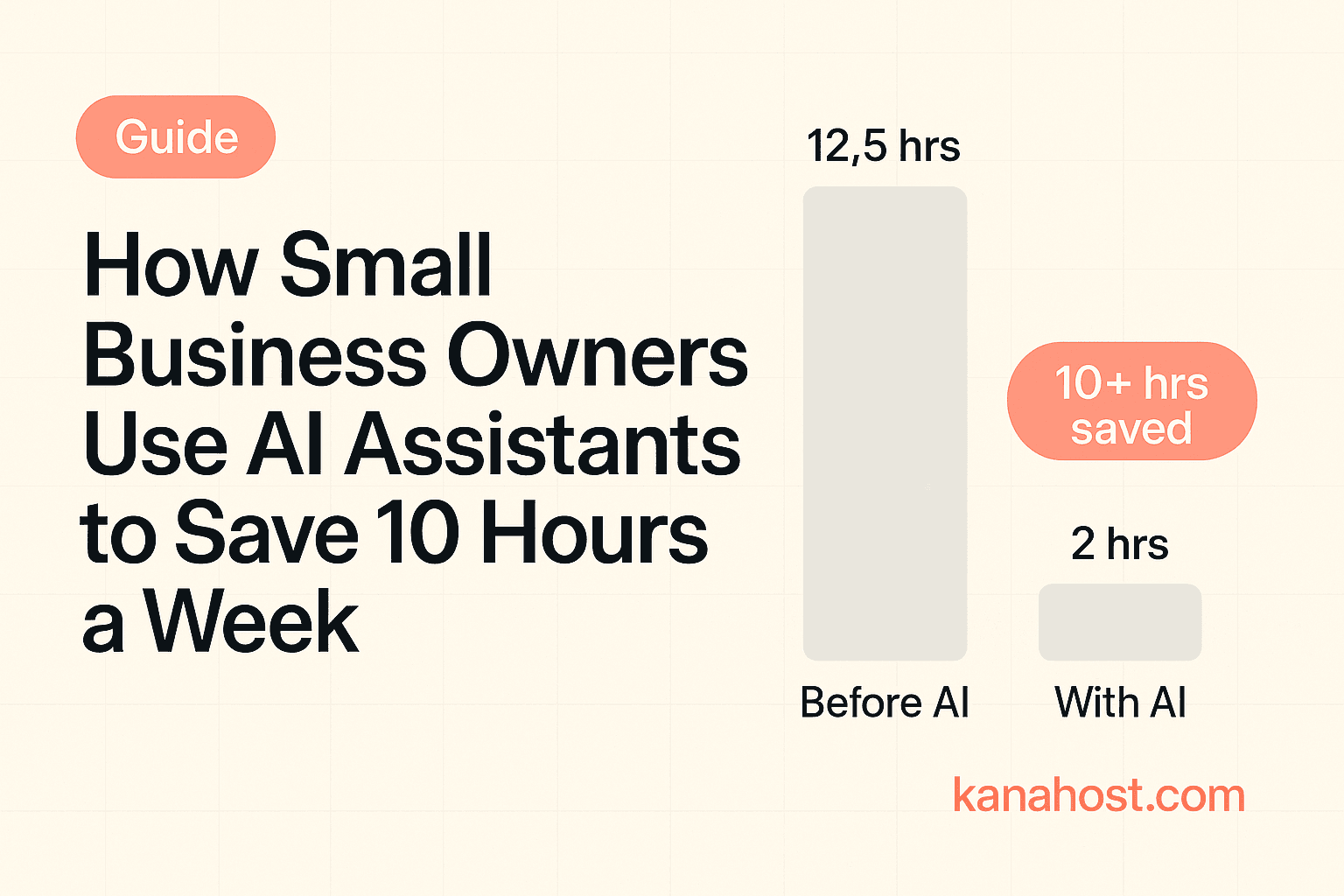
| Total | 12.5 hours/week | ~2 hours/week | ~10.5 hours/week |
These aren't theoretical numbers. They're based on actual usage patterns from business owners running AI assistants for daily operations.
How It Happens
1. Email Triage
Your AI assistant reviews your inbox, flags what needs your attention, and archives the newsletters and junk. You only interact with what matters. The key isn't just sorting — it's summarization. Instead of opening 40 emails to figure out which 5 matter, you read a one-paragraph summary and deal with the important ones.
2. Effortless Scheduling
Instead of back-and-forth emails, you tell your assistant: "Schedule a time with John next week." It sends the invite, blocks your calendar, and reminds you when it's time. No more "Does Tuesday at 2 work?" ping-pong across five emails. The assistant checks both calendars and proposes a time that works.
3. Research on Demand
You don't have to spend your morning reading reports to stay informed. You ask your assistant to summarize the market news, competitor moves, or project updates before you start your day. Need to prep for a client meeting? "Give me a 2-minute brief on Acme Corp" — and you walk in prepared instead of winging it.
4. Competitive Monitoring
Your assistant can keep an eye on your competitors, tracking their price changes or new service announcements, so you don't have to hunt for the information. It checks periodically and only alerts you when something actually changes. No more manually browsing competitor websites every week.
What You Do With That Time
Ten hours a week isn't just time. It's focus. It's time you can put toward high-value work: talking to customers, refining your service, developing new products, or finally taking that afternoon off.
Think about it in dollar terms. If your hourly rate is $100, that's $1,000 per week — over $50,000 per year — in recovered productive capacity. Against a $49/month assistant, the ROI isn't even a question.
The businesses that adopt AI assistants earliest aren't the ones with the biggest budgets. They're the ones who recognized that their time was being consumed by tasks a machine could handle better, faster, and more consistently.