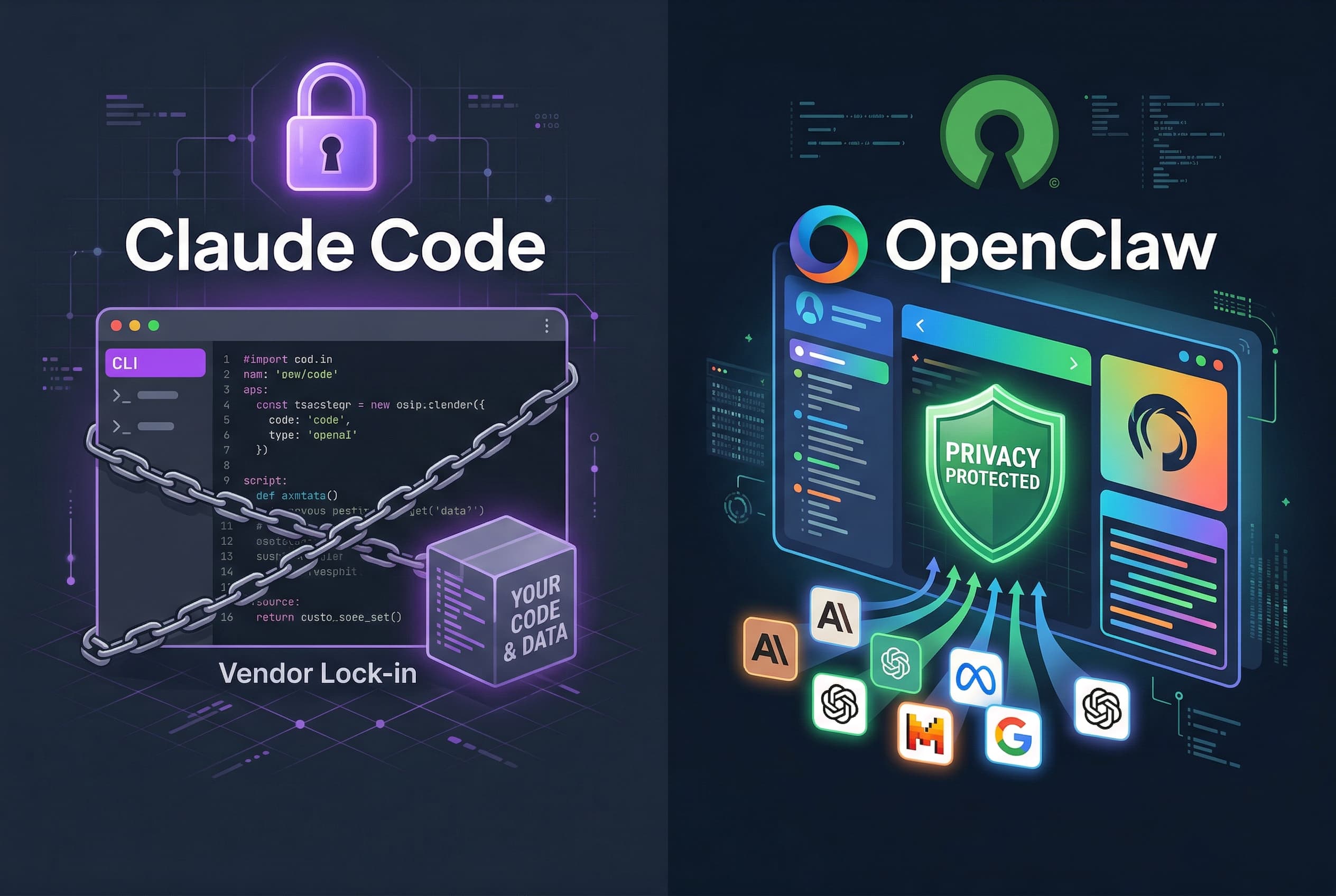
Anthropic's Claude Code has been making waves in the developer community since its launch. It's a genuinely capable tool: agentic coding, persistent sessions, tool use, multi-step reasoning directly in your terminal. If you're deep in the Anthropic ecosystem, it's easy to see the appeal.
But there's a growing conversation in developer communities about what Claude Code *isn't* — and what that means for teams who care about model flexibility, data privacy, and long-term independence. That conversation is why we're writing this article.
This isn't a hit piece on Claude Code. It's a fair look at what each tool actually offers, where each one wins, and how to decide which one belongs in your workflow.
What Is Claude Code?
Claude Code is Anthropic's official CLI (command-line interface) tool designed for agentic coding tasks. You install it, point it at your codebase, and it can autonomously browse files, run commands, write code, and work through complex multi-step tasks — all from your terminal.
It's powerful. Anthropic's Claude 3.5 and Claude 3.7 models are among the best available for code understanding and generation. The tool integrates tightly with the model, which means you get a polished, optimized experience for Anthropic's capabilities specifically.
The catch: that tight integration cuts both ways.
What Is OpenClaw?
OpenClaw is an open-source AI agent platform designed to be model-agnostic, self-hostable, and always-on. It powers personal and professional AI assistants that run on your own infrastructure — or managed infrastructure like [KanaHost](/pricing) — and connect to virtually any AI model on the market.
Unlike Claude Code, OpenClaw isn't a CLI tool you spin up for a session. It's a persistent, multi-channel AI system that lives on your server and works continuously on your behalf — available via Telegram, WhatsApp, web, Discord, Slack, email, or a native mobile app.
Feature Comparison
| Feature | Claude Code | OpenClaw (via KanaHost) |
|---|---|---|
| Model Support | Anthropic only (Claude) | Any model: Claude, GPT-4o, Gemini, Llama, Mistral, and more |
| Self-Hosting | No — runs through Anthropic's servers | Yes — full self-hosting or managed via KanaHost |
| Privacy | Your code/data goes through Anthropic's infrastructure | Runs entirely on your own server; zero third-party access |
| Always-On | No — CLI session-based; you start it each time | Yes — 24/7 persistent agent with proactive capabilities |
| Persistent Memory | Limited in-session context | Long-term memory across all sessions and channels |
| Multi-Channel Access | CLI only | Telegram, WhatsApp, Discord, Slack, web, email, mobile |
| Plugin / Skill Ecosystem | No | 700+ skills; custom plugin development |
| Custom Agents | No | Full multi-agent support with spawnable sub-agents |
| Pricing Model | Pay-per-token (Anthropic API rates) | Flexible: bring your own API keys, self-host, or managed |
| Open Source | No | Yes — fully auditable code |
| Developer API | Limited | Full API; extend and integrate freely |
| Multi-Agent Workflows | No | Yes — group chats, orchestration, sub-agent delegation |
Deep Dive: Where Each Tool Wins
Model Flexibility — OpenClaw Wins
This is the most significant structural difference between the two tools, and it's worth thinking through carefully.
Claude Code is locked to Anthropic's models. Full stop. If Anthropic's pricing changes, if a new model from Google or OpenAI outperforms Claude for your specific use case, or if you want to run a local open-source model for sensitive work — you can't. You're renting capability from one vendor with no exit ramp.
OpenClaw is designed from the ground up to be model-agnostic. You can run Claude 3.7 today, switch to GPT-4o for a specific task tomorrow, use Gemini for multimodal work, or run Llama 3 locally for maximum privacy. You're not locked to any single company's roadmap, pricing decisions, or model capabilities.
For individual developers, this might sound academic. But for teams or businesses building workflows on top of AI, vendor lock-in is a real strategic risk. The best model in 2026 may not be Claude. Flexibility to choose matters.
Privacy & Data Ownership — OpenClaw Wins
When you use Claude Code, your code — your proprietary business logic, your unreleased features, your client data, your internal tooling — travels through Anthropic's servers for processing. Anthropic's privacy policy governs what happens to that data.
For many projects this is fine. But for work involving:
- Client confidentiality (law, consulting, finance)
- Proprietary algorithms or trade secrets
- Healthcare data (HIPAA concerns)
- Internal enterprise tooling you'd rather not expose
...sending that code through a third-party API is a non-starter.
OpenClaw deployed via KanaHost (or self-hosted) runs entirely on infrastructure you control. The model API calls go to whichever provider you've chosen — you control those relationships too. Your code never touches a "shared" server; it stays in your environment.
We've written more about [why AI privacy matters](/blog/ai-privacy-why-it-matters) if you want the full picture.
Always-On vs. CLI — OpenClaw Wins (for most workflows)
Claude Code is a tool you invoke. You open a session, work through a task, and close it. It doesn't monitor your systems, it doesn't send you a morning briefing, and it doesn't fire a webhook when a CI build breaks at 3 AM.
This is a deliberate design choice — it's a developer tool, not an operating system.
OpenClaw is an always-on agent. It wakes up when your cron job fires. It monitors for events. It sends you a Telegram message when the PR is merged or when an error rate spikes. It runs background research while you sleep and delivers the summary when you start your day.
If you're building the kind of autonomous, event-driven workflows that developers increasingly want — OpenClaw's always-on architecture is the right foundation. Claude Code's session model isn't designed for that.
Multi-Channel Access — OpenClaw Wins
Claude Code lives in the terminal. That's where it begins and ends.
OpenClaw meets you where you are. The same agent you're working with on your laptop is accessible from your phone via Telegram, from your desktop via the web interface, or from a team channel in Slack. Your conversation history, your memory, your active tasks — all of it is consistent across channels.
For developers who move between contexts constantly (desk, mobile, team standups), that unified multi-channel presence is genuinely useful. It's not a gimmick — it's the difference between an assistant that's available and one that you have to remember to go find.
Developer Experience for Pure Coding Tasks — Claude Code Wins (Narrowly)
Let's be honest: for pure, focused, head-down coding sessions, Claude Code's tight integration with Anthropic's models gives it a polished edge. The tool is deeply optimized for this single workflow. It knows how to navigate large codebases, reason about file structure, and execute complex refactors with a level of coherence that comes from vertical integration.
OpenClaw is flexible by design, which means it's not as surgically optimized for any single use case. If you're a solo developer who wants the absolute best coding copilot for intensive 2-hour deep dives, Claude Code may feel sharper in that specific lane.
That said, OpenClaw's multi-model flexibility means you can route coding tasks to whatever model performs best for your stack — including Claude if that's your preference. You're not giving up model quality; you're choosing to use it on your own terms.
Pricing — Depends on Your Usage
Claude Code uses Anthropic's API pricing. You pay per token, at Anthropic's rates, with no option to substitute a cheaper or more capable model for specific tasks.
OpenClaw lets you bring your own API keys for any provider. You control your model spending — use a cheaper model for routine tasks, a powerful one for complex reasoning. With [KanaHost managed hosting](/pricing) starting at $50/month, you get the infrastructure handled professionally while retaining control over your model costs. For many teams, this comes out significantly cheaper than equivalent Claude Code usage at scale.
Who Should Use Claude Code?
Claude Code is a good fit if:
- You're primarily a solo developer doing intensive coding sessions
- You're already comfortable with Anthropic's ecosystem and not concerned about lock-in
- You want a polished, zero-configuration tool that works immediately
- Privacy isn't a primary concern for the code you're working on
- You don't need always-on behavior or multi-channel access
Who Should Use OpenClaw?
OpenClaw (via KanaHost) is a better fit if:
- You want freedom to use any AI model — now and as the landscape evolves
- You need privacy and data sovereignty — your code stays on your server
- You want an always-on agent, not just a session-based tool
- You work across multiple channels (Telegram, Slack, mobile, web)
- You're building multi-agent workflows, background automation, or event-driven systems
- You want the economics of managing your own model spend rather than paying Anthropic's rates
- You need a customizable, extensible platform rather than a fixed tool
The Bottom Line
Claude Code and OpenClaw are solving related but fundamentally different problems. Claude Code is a premium, vertical, session-based coding assistant. OpenClaw is a horizontal, always-on, model-agnostic AI agent platform.
The choice isn't really about which one is "better" — it's about what you're building and what you need long-term. If you're happy in the Anthropic ecosystem and your work is primarily solo coding sprints, Claude Code delivers. But if you're thinking about where AI agents are going — persistent, multi-channel, model-agnostic, privacy-respecting systems — OpenClaw is built for that future.
Try OpenClaw Without the Setup
OpenClaw's power is most accessible when you don't have to manage the infrastructure yourself. KanaHost provides managed OpenClaw hosting — professional-grade deployment, security hardening, automatic updates, and 99.9% uptime — starting at $50/month.
You get model flexibility, privacy, always-on capability, and multi-channel access. Without the server management. Without the vendor lock-in.
[View KanaHost Pricing →](/pricing) | [See All Features →](/features)